

2 years ago, I decided to develop my LinkedIn and Twitter profiles. Now I see that it was the right bet, but getting results on them is getting harder and harder, and you have to consider organic activity on them only as part of your overall marketing strategy.
What has changed during this time?
1/ More and more people are posting
The cost of 1000 impressions of a post in LinkedIn advertising on tier 1 markets ranges from $40–$100, depending on how good your post is in terms of CTR.
2 years ago, getting 1000 impressions on a post was quite easy, and if someone wrote a post in under 30 minutes, it often had a good ROI for many people. So more and more people try to use this opportunity, and this increases the overall competition for attention.
2/ Platforms have shifted to promoting content based on interests and engagement
Platforms want people to spend more time in their newsfeed, and popular posts, even from strangers, are better at holding a user’s attention.
The same Facebook years ago promised that it would make friends read each other more, but it ended up the same.
The truth is that most people write uninteresting, low-value content. Plus, some of those who write something valuable and unique cannot design it in such a way that people stop in the feed and read it to the end.
As a result, each of your posts is either a hit or a miss. The distribution of winners is the same as in sports, music, and cinema.
3/ Using AI for commenting and posts
About 50% of the comments I receive under my posts are AI comments. The most unpleasant thing is that even CEOs, founders, and C-levels of normal companies often resort to this automation, not just freelancers who want to offer you links.
When I see a person doing this, I don’t want to communicate with them anymore. In my opinion, AI simplifies gaining visibility, but kills reputation.
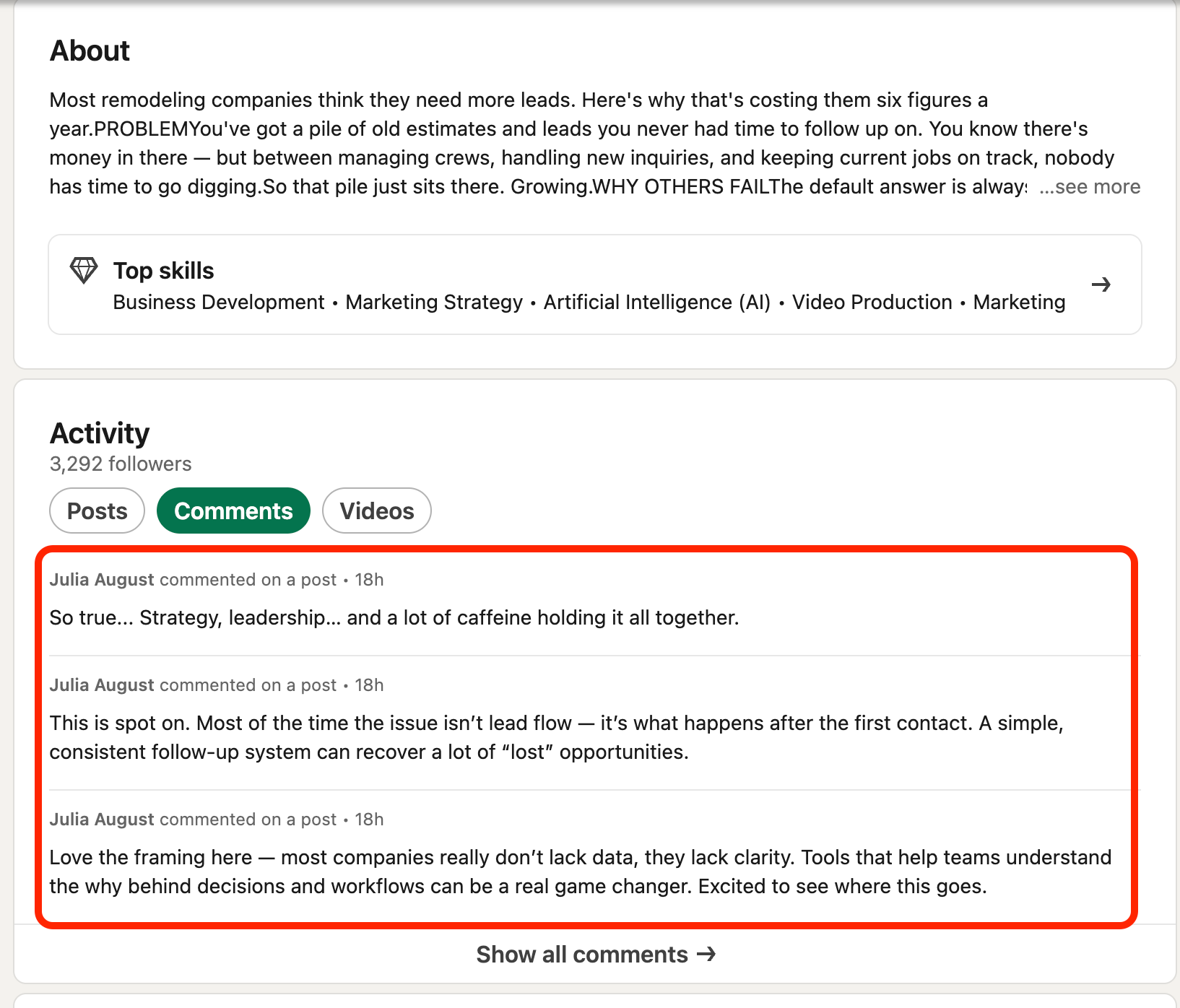
The easiest way to detect people who leave AI comments is to visit their profiles and check the last 3 comments. Usually, there are 3 long comments left in the same minute under different posts, which is impossible for real discussions.
I understand its use for Reddit SEO or elsewhere, where anonymous accounts are used, but in a professional network, where each of your posts is evaluated to see if it makes sense to work with you, it looks short-sighted.
These three trends lead to an interesting effect. Posts from influencers with 30k-50k followers often get the same number of views as those with 3k-5k followers.
For me, if a post gets 1000 views now, that’s a good result. So, how do I adapt to these changes to continue growing on LinkedIn?
1/ Constantly asking why people add me to connections
A large part of the impact of your posts cannot be easily attributed to likes and comments. Most people who read your posts do not like or comment on them, but they do affect whether you are remembered and chosen.
I began to notice this when I started asking everyone who added me as a friend what interested them in my profile. And they write that they read my content, although I have never seen them among the participants in the discussions.
1000 people who meet your ICP and read you regularly, this is a potentially $50k-100k MRR business, for a product where the minimum ARPU is $100/m.
2/ I treat content on social media like work
For a long time, I treated it as some kind of side activity that could potentially help the business somehow. Now I see that this is my main lever for the business.
Every post is a potential candidate for thought leader ads, which can bring dozens of leads.
When I find a topic that triggers people, I try to write a few more posts, but from different angles.
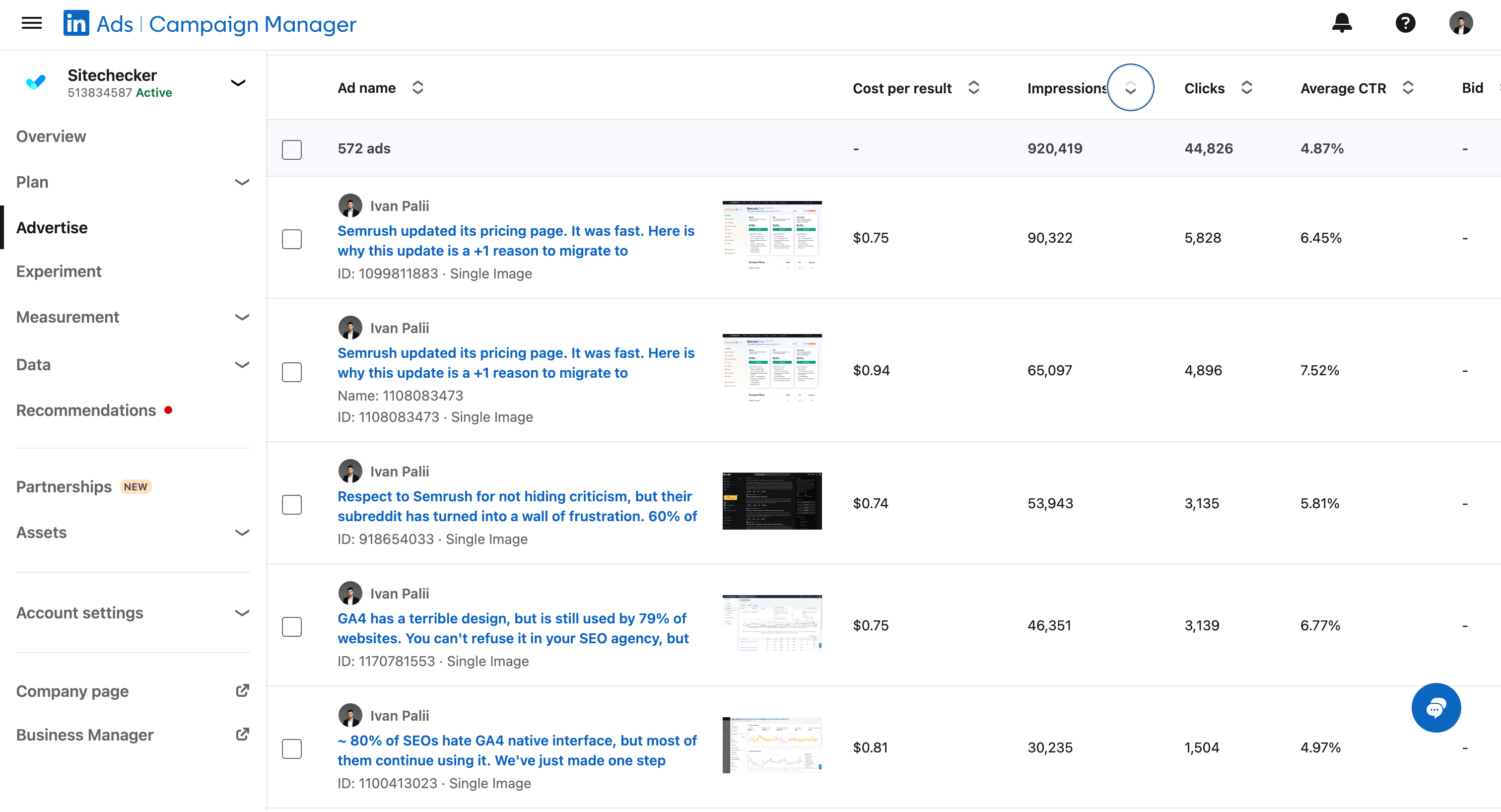
For example, the first post about Semrush went down very well, after that posts about the Semrush subreddit, their sale to Adobe, pricing changes, and 4 reasons to move to Sitechecker were born.
All these posts went into advertising, and now they are leading among all our campaigns in the number of demos.
A certain change of mindset is needed here. It always seemed to me that writing about the same thing is bad; it shows intellectual laziness, but this is exactly what is needed for business.
3/ I use thought leader ads on LinkedIn as the main advertising channel
So organic reach is falling. But even before, for posts where you are selling your product, you could not get the organic reach that you would like and to the audience that you need.
Thought leader ads are a great lever. Yes, you have to pay for promotion, but how much you have to pay for each click depends again on your writing skills and understanding of what hurts your audience.
For now, these ads are our main channel for attracting customers. According to my statistics, the ideal thought leader post has a CTR of 8-10%. In this case, for the US market, a click costs about $0.7-$0.8.
4/ I am changing the perception of the impact of content
I am increasingly seeing that constant posting is not only about attracting new customers, but also about retaining old customers.
Sometimes, a good post is an educational product that provides additional value to your audience. And visionary posts, where you show where you are moving your product and why, give a sense of perspective and understanding why it is not worth canceling the subscription.
5/ I create lead magnets that I distribute via LinkedIn direct messages
We recently surveyed 73 SEO agencies on how they are adapting to AI search, what they are doing with pricing, margins, growth, etc. Based on this, we made a nice report.
And thanks to the activity in the past 2 years in building contacts, I can send this report directly to potential clients via direct messages.
What are your strategies to adapt to the trends I mentioned? Or do you just stop posting?
Read also: